
| Sandra Ikegwuruka
What if the answers to some of Africa’s health challenges could begin inside a cell?
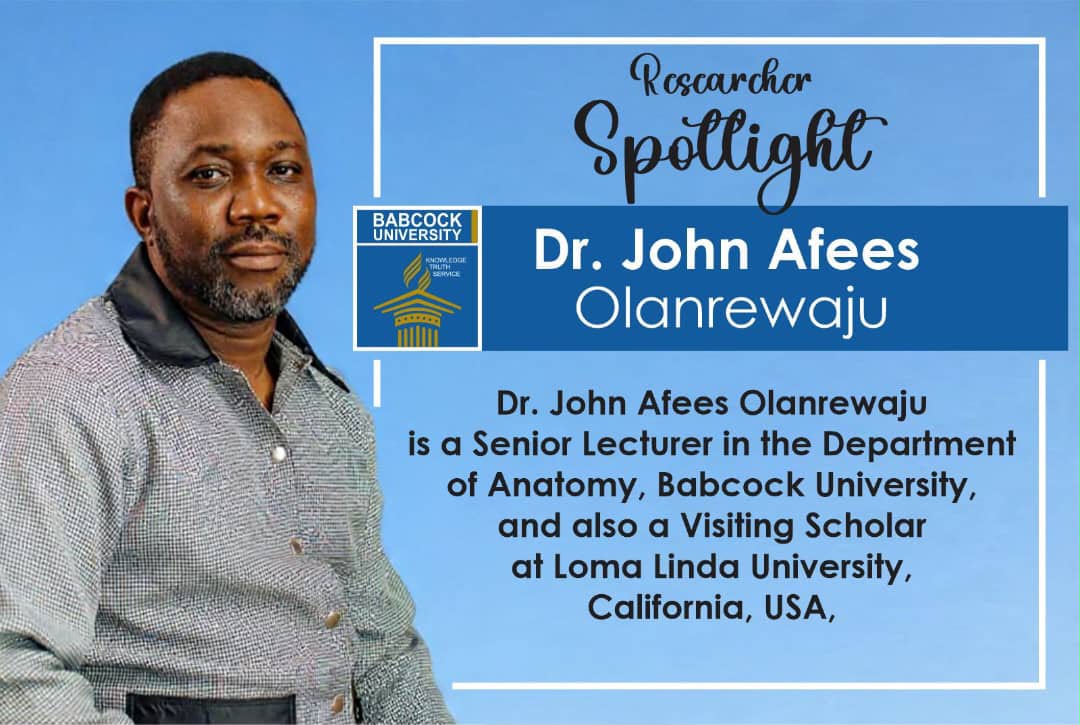
Meet the Babcock researcher Dr. John Afees Olanrewaju
Senior Lecturer, Department of Anatomy, Ben Carson College of Health and Medical Sciences, Visiting Scholar, Loma Linda University, California, USA) exploring the space between molecular discovery and human health.
What are you currently researching?
I am studying breast cancer, particularly aggressive forms that affect women of African ancestry. My recent research in Dr. Eileen Brantley’s laboratory at Loma Linda University focused on DNA methyltransferase 1 (DNMT1), an enzyme that helps regulate how genes are switched on and off, and whether a naturally occurring compound called rutin could affect breast cancer cells through this pathway.
What problem inspired you to pursue this research?
I was motivated by the high burden of aggressive breast cancer among women of African ancestry and the fact that African populations are still underrepresented in much of cancer research. I wanted to investigate biological differences that may influence how breast cancer develops and responds to treatment, while exploring approaches that could eventually contribute to better treatment options.
What have you discovered so far?
Our findings showed that different breast cancer cells do not respond to rutin in the same way. In some of the models we studied, particularly those relevant to women of African ancestry, rutin reduced cancer cell growth and was associated with reduced DNMT1 levels and activity. These early findings provide a reason to investigate this pathway further.
Why does this research matter beyond the university?
Cancer treatments are increasingly becoming more personalised, but many of the studies guiding these treatments have included relatively few people of African ancestry. Research using more diverse cancer models can help us understand whether biological differences influence treatment response and contribute to cancer care that is more representative of the populations it is intended to serve.
Who could benefit from your findings?
Ultimately, the people we hope will benefit are women living with breast cancer, particularly women of African ancestry. The research may also help scientists and clinicians better understand differences in breast cancer biology and provide evidence for developing and testing treatment approaches in more diverse patient populations.
What has your research journey taught you?
This research has taught me that an idea discovered through computer-based research is only the beginning. It needs to be tested experimentally before we can understand its real biological significance. Working in Dr. Brantley’s laboratory gave me the opportunity to take an idea that originated from our research in Nigeria and begin testing it directly in breast cancer cells.
If your research succeeds, what could change?
If further studies confirm our findings, we could gain a better understanding of how targeting DNMT1 may help control certain forms of breast cancer. More broadly, I hope this work contributes to cancer research that better represents African populations and demonstrates how discoveries originating in Africa can progress from computer-based studies to laboratory testing and, ultimately, towards improving patient care.
What are the next steps for your research?
The next step is to test these findings in more advanced models that better reflect what happens in patients. We hope to expand the work using additional breast cancer cell models, patient-derived samples and three-dimensional models such as organoids, while incorporating genomic information from African patients. This will help us determine whether the findings are consistent and whether they could eventually support the development of more precise treatment approaches.
Notable Publications / Grants
- Union for International Cancer Control (UICC) YY Study Grant, 2025–2026: “Targeting DNMT1 as a therapeutic strategy to impede breast cancer disparities.”
- International Society for Neurochemistry (ISN) Career Support Committee-funded research on mitophagy using Drosophila models.
- 2026 cancer review publication and two AACR 2026 research abstracts, alongside ongoing work in cancer biology, genomics and translational precision medicine.
Ongoing Research Projects
- DNMT1-targeted breast cancer research, including natural-product modulation, mammalian cell models and development toward patient-derived organoid studies.
- Development of an AI-ready breast cancer registry and multimodal precision-oncology research platform for Nigerian women, integrating pathology, genomics and computational analysis.
- Functional studies of redox adaptation and drug-tolerant states in colorectal cancer models, with emphasis on African-relevant disease biology.
- Mitophagy and neurodegeneration research using Drosophila genetic models, with capacity development in functional genomics.
Awards / Recognitions
- Union for International Cancer Control (UICC) YY Study Grant awardee, with advanced research training in translational breast cancer biology.
- ISN Career Support Committee grant awardee for neuroscience research and laboratory capacity development.
- Selected by the Babcock University Office of Research, Innovation and International Collaboration for the Research Catalyst Profile feature.
Links to Research: