
| Communications Department

Provost of the Babcock School of Law & Security Studies, Prof. Dorcas Odunaike, (left) with Prof. of AI, Prof Afolashade Kuyoro.

Prof. Jonathan Nwosu (2nd left) with RIIC Research Capacity Building workshop coordinators (from left - right): Prof. Adebowale Adetayo, Dr. Chinedu Anokwuru, and Prof. Kolawole Ayodele.

A cross section of participants. Third left is the Head of Medical Laboratory Science Department, Prof. Esther Adejumo.

Dr. Chinedu Anokwuru

A cross section of participants at the workshop

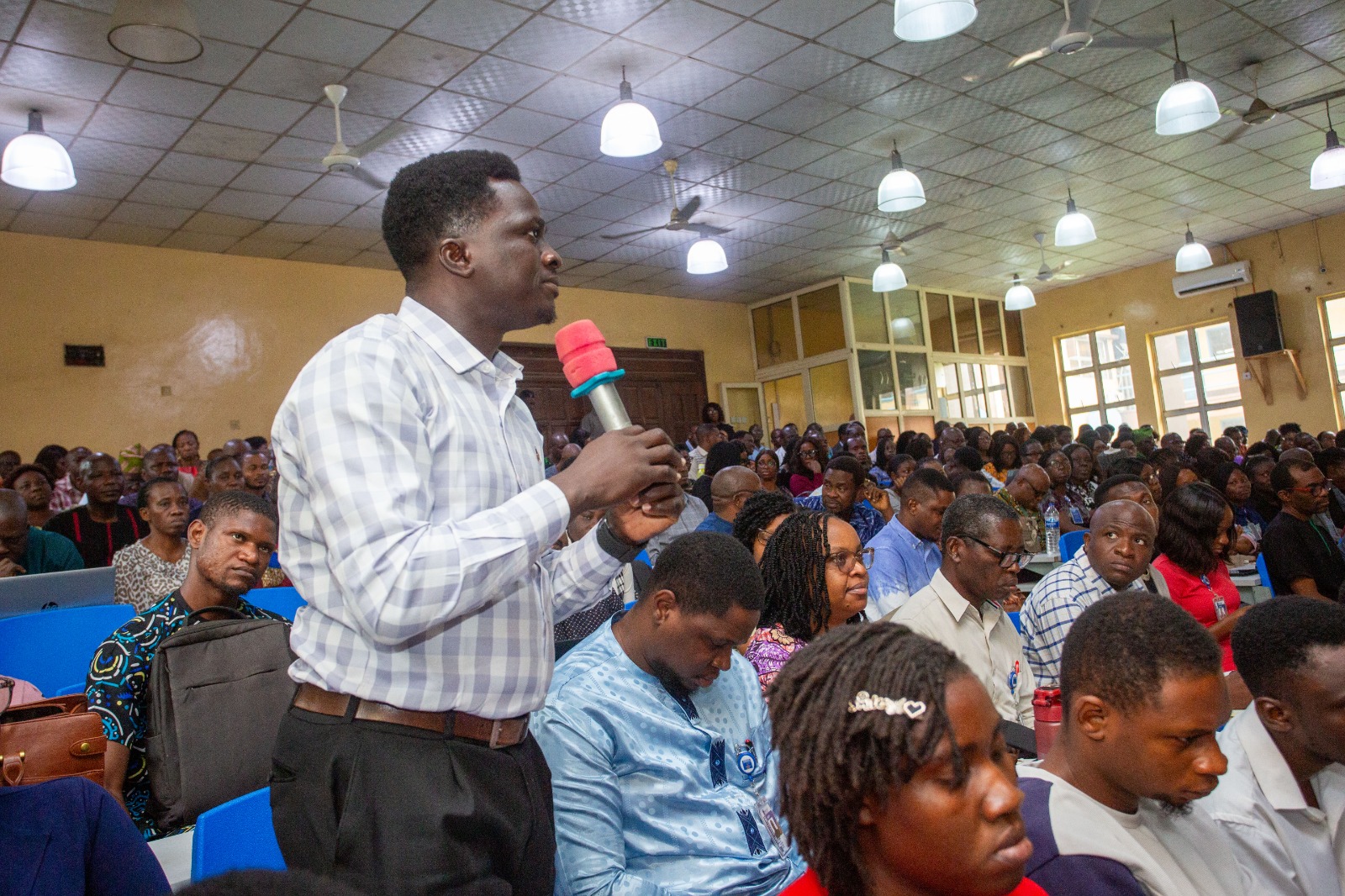
A faculty member raises a point at the Research Capacity Building workshop.
As Nigerian universities race to improve their global rankings and visibility, Babcock University has stepped forward with a bold initiative: a structured, three-week capacity-building workshop designed to sharpen faculty skills in research, publication, and grant writing. Convened by the Office of Research, Innovation and International Collaboration (RIIC), the programme underscores the institution’s determination to remain globally competitive and research-focused.
Declaring the session open, BU President/Vice Chancellor, Prof. Afolarin Ojewole, stressed the importance of visibility in research. Represented by the Senior Vice President (Academics), Prof. Jonathan Nwosu, Prof. Ojewole noted that researchers should be seen and known for their output.
“As an institution aiming to remain globally relevant and research-focused, we must leverage our collective strengths and knowledge for growth and development,” he said.
The sessions featured insights from leading facilitators. Dr. Chinedu Anokwuru, Deputy Director of RIIC, explained the workings of scholarly publishing, journal indexing in Scopus, Web of Science, PubMed, DOAJ, and AJOL, and the importance of journal metrics. He also addressed issues on article processing charges and waivers available to Nigerian authors.
Dr. Adebowale Adetayo added practical strategies for improving manuscript acceptance rates, warning against predatory journals and highlighting red flags that researchers must avoid. His presentation stressed on the pitfalls that can undermine credibility and offered clear guidance for navigating the publishing landscape.
“With predatory journals, you don’t only lose finance, you lose your effort, time and opportunities for citations. They are always in a hurry to get your work and often create false names of non-existent board members aside making misleading claims about the operation, such as a false location,” he said.
Participants described the workshop as “well-timed and relevant,” as well provided actionable tools to strengthen their research output and grant writing capacity. They emphasized that sustained collaboration between faculty and the University would ensure that Babcock continues to build excellence, enhance visibility, and secure its place among globally ranked institutions.